|
Contact: Julie Cook, Cook Bowe Communications (978) 317-2030; julie@cookbowe.com Camille Myers Breeze, Museum Textile Services (978) 474-9200; info@museumtextiles.com Long May It Wave: Rare 19-Star USS Constitution Flag Gets Special Treatment by Local Conservator. Museum Textile Services Helps Preserve Flag Owned by H. Ross Perot, Sr. Andover, MA, May 25, 2016 – A rare 19-star flag that once flew on America’s first battleship, the USS Constitution, also known as “Old Ironsides,” is being conserved by Museum Textile Services, the premier textile conservation studio in New England. The flag is owned by former US presidential candidate H. Ross Perot, who received it as an 80th birthday gift from his son, Ross Perot, Jr., in 2010. It will be surface cleaned, stabilized and mounted for long-term display at the Perot Companies Corporate headquarters in Texas. “American history is preserved and venerated through its national symbols. What greater symbol can there be than an American flag that flew over the U.S.S. Constitution nearly 200 years ago? We are proud to be the stewards of this great flag, to help preserve it and to share the meaning of its history for generations to come,” said Ross Perot, Jr. The number of stars dates the wool ensign to circa 1816. As one of the earliest and rarest colors in the USS Constitution collection, 19-star flags were authorized for use for one year, from December 1816 to December 1817. The following year, Congress passed the Third Flag Act of 1818, which provided for 13 stripes and one star for each state, to be added to the flag on the fourth of July following the admission of each new state. It wasn’t until the Executive Order of June 24, 1912 that the order of the stars and proportions of the U.S. Flag were codified. Before that, flags sometimes had unusual arrangements of stars and odd proportions based on the discretion of the flag maker.
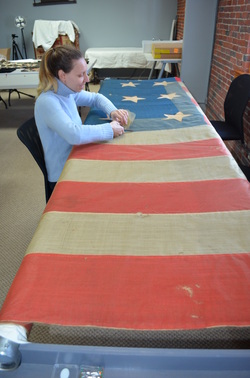
According to Camille Breeze, Director and Chief Conservator of Museum Textiles Services, the flag is from a group of flags with provenance to the Constitution that had been in the same collection for 150 years. “It is a great historical coincidence that this particular flag is being worked on in the Boston area while the USS Constitution is presently in dry dock for maintenance and repair at the Charlestown Navy Yard. Given the 19 stars, the flag was associated with ‘Old Ironsides’ when the ship was also in dry dock from 1815 to 1821, just 100 years ago,” she said. “The flag was likely not flown over water or in battle, but would have served as an important patriotic symbol while the boat was out of the water.” Despite its lack of combat action, inevitable wear and tear over nearly 200 years has taken its toll on the flag. However, it is still in remarkably good condition. It measures 16’8’ wide by 10’6” high and has 9 stripes. The hoist is missing, there are some tears, losses and discoloration to stars, missing stripes, patches, as well as scattered holes or tears. Portions of this ensign appear to have been removed, possibly by 19th Century souvenir hunters. The goal is to improve the flag’s preservation level by removing pollutants, stabilize it with a minimum of hand-stitched repairs, correct distortion using water vapor, and realign it. The rest of the conservation work will be done onsite during installation. Treating some of our most significant cultural heritage materials is second nature for Ms. Breeze. Since founding Museum Textile Services in 1999, she has worked on more than 1,500 objects including military uniforms, presidential garments, royal tapestries, sacred textiles, quilts, and childhood embroideries. Locally, the organization has included such varied projects of note as: Dear Boston: Messages from the Marathon Memorial; the conservation of 18 Tibetian Tangkas from the Mead Art Museum at Amherst College; and the National and Regimental Colors of the 54th and 55th Massachusetts Infantry Regiments, the first official African American units in the United States during the Civil War made famous in the 1989 motion picture Glory. This 19-star USS Constitution flag was originally in the collection of philanthropist and collector of early American decorative and fine arts H. Richard Dietrich, Jr. In April 2012, it was sold by Freeman’s auction house. The flag was purchased by Ross Perot, Jr. and presented to his father H. Ross Perot, an avid steward of American history, for his eightieth birthday. The flag was displayed in the former Perot Systems headquarters in Plano, Texas until it was removed for conservation. The flag will be featured in an entirely new installation at the new Perot Companies’ headquarters in Dallas at the end of this year. Boston-based exhibition design firm, Amaze Design, is developing the flag exhibition, along with other exhibits at the new campus. The flag will be made available to select media for viewing during interviews, but the public cannot see it during the conservation phase. To learn more, please visit www.museumtextiles.com or call 978–474–9200. About Museum Textile Services Museum Textile Services is one of just a handful of independent conservation studios that specialize in preserving textiles that are under the care of private individuals, cultural heritage institutions, and government agencies. It documents, cleans, stabilizes and mounts historic textiles. Through educational programs and outreach initiatives, Museum Textile Services teaches individuals and cultural heritage institutions how to ensure better preservation of their textiles. For more information, visit www.museumtextiles.com. ### PHOTOS: (High resolution versions available on request) 1. The rare 19-star flag, owned by H. Ross Perot, likely flew on the Constitution while she was in dry dock during 1816 and 1817. 2. Museum Textile Services staff conserve an ensign flag belonging to the Dennis, MA Historical Commission.
1 Comment
Andover, MA. – Museum Textile Services will be the site of a March 14, 2016, seminar for families, collectors and museum staff seeking to understand the stories that military uniforms tell. The one-day workshop allows participants to delve into military tradition using photographic references and a wealth of actual historical artifacts. They will learn how to gather data from the uniform itself, giving context to the garment and the individual who wore it. Workshop participants will learn to differentiate between uniforms from the different service branches and date them by their adornments, style and cut. Proper display and storage of uniforms will be illustrated. A bibliography of published resources, both digital and print, will be provided to attendees. “Uniforms are found in almost every museum collection across the country, from small house museums to street-side attractions and air museums,” says military specialist and instructor, Dylan Almendral. “They are sourced from aging veterans, the descendants of service men and women, and civically minded ‘pickers.’ Many families, curators, and collections specialists do not know how to identify and give context to the uniforms in their collections, so these garments end up unseen and their stories unheard.” “Roland and I are very excited to share our knowledge and skills to ensure that military uniforms and their invaluable stories are appreciated. Each participant should look forward to a very interactive and enlightening seminar. Thank you very much to Museum Textile Services for sponsoring us.” This workshop is open to museum staff and volunteers, private collectors, and descendants who are seeking to learn the stories that uniforms can tell. Participants are invited to bring one uniform of interest for class exercises. Archival storage boxes and manikins are available for purchase. To register for the seminar, visit www.museumtextiles.com/identifying-uniforms to download the registration form, or call 978–474–9200. The course fee, including box lunch, is $50. About the Instructors Dylan Almendral is a military specialist who researches individuals to whom objects belonged in order to tell their stories. Dylan has interviewed over 250 people, from WWII veterans to classic Hollywood actors. In 2013, Dylan published a photographic history of Victorville, California, for Arcadia Publishing’s ‘Image’s of America’ series. That same year, he co-founded the American Legacy Museum. As lead researcher, collections manager and curator, Dylan oversees over 500 military uniforms from the Great War through to the Vietnam era, as well as 200 pieces of costume from some of the most memorable films of Hollywood’s Golden Era. Roland Gonzalez is a living historian representing the WWII generation. He has performed extensive research in the intricacies of the WWII uniform and equipage for both the American and German militaries, amassing a collection of rare uniforms, photographs and documents. Roland has applied his knowledge and talent to helping collectors and families learn more about their loved ones. As an intern at the American Legacy Museum, he specialized in identifying rare uniform variants of the United States Army Air Forces (USAAF). About Museum Textile Services Museum Textile Services, the premier textile conservation studio in New England, specializes in the preservation of fabric-based materials for cultural institutions and individuals. Museum Textile Services documents, cleans, stabilizes and mounts historic textiles. Through educational programs and outreach initiatives, Museum Textile Services teaches individuals and cultural heritage institutions how to ensure better preservation of their textiles. For more information, visit www.museumtextiles.com. 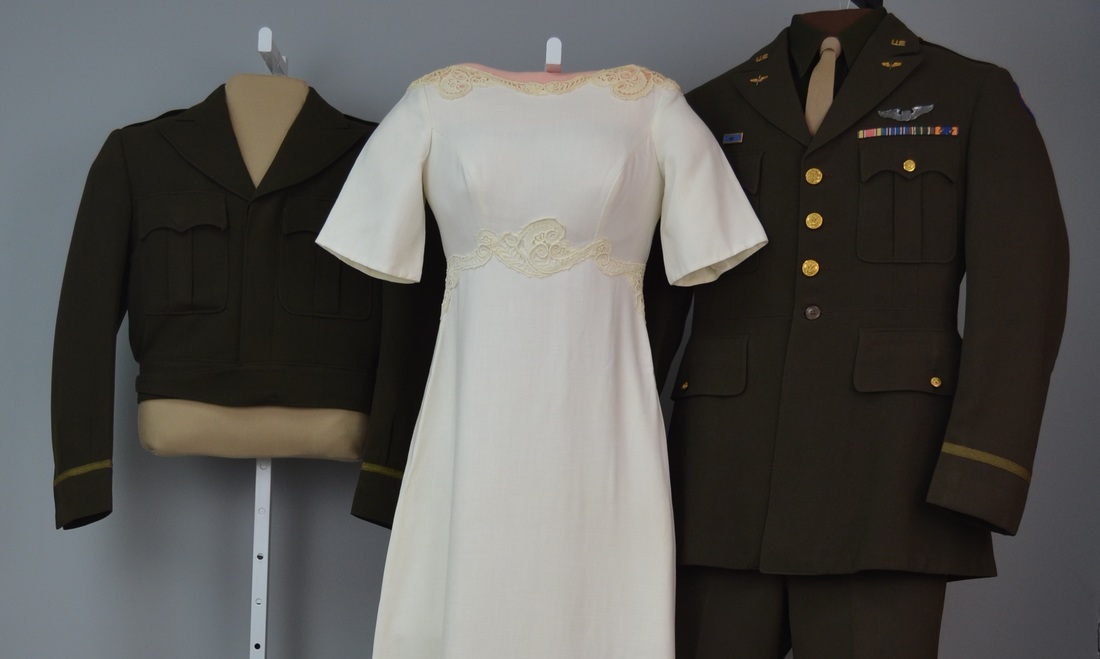 Uniforms of WWII pilot Max W. Krell. Photo courtesy of Museum Textile Services. Andover, MA – Museum Textile Services will install a rare 13-star naval flag, believed to be made in the mid 19th century, at South Dennis’s Wixon Middle School next month. The extremely large flag, which is now cared for by the Dennis Historical Commission, was originally given to the Dennis Historical Society in 1970 by descendants of Captain Bernard O’Neil (1822-1889). In 1975, the Wixon Middle School was selected as the public location in which the flag would be displayed. Camille Myers Breeze, Director of Museum Textile Services, oversaw the conversation effort and will supervise the installation process. “This appears to be a ceremonial flag used by the U.S. Navy to declare the country of origin of the sailing ship as it entered a foreign port. It’s incredible to imagine just where in the world the flag has been. And now, it has made one more journey: up to the conservation studio in Andover, where the flag was cleaned with a gentle hand vacuum and vulcanized rubber sponges. Meticulous repairs were made by hand while the flag was rolled on a 12-foot-wide tensioner. In just a short time, the flag will return to Dennis and once again be at rest.” The 13-star flag is hand sewn of wool bunting with cotton appliqué stars. Given its size and age, the flag is in remarkable condition. It has hung in the auditorium at the Wixon Middle School for more than 25 years, where it accumulated dust and began to show strain from being stapled to a wooden beam. “As conservators, we have the opportunity to play a small part in the story of the historic artifacts we are asked to protect,” Camille said. “In this case, we were working with simple fabrics—wool and cotton—that were hand-stitched over one hundred and fifty years ago.” A team of conservators from Museum Textile Services will arrive at Wixon Middle School on July 8th to begin mounting the flag on a custom museum panel. By the morning of July 10th it will be installed into a new 118 x 180 inch frame. The frame will be hoisted onto the auditorium wall later that day with the help of Artex Fine Art Services of Somerville, MA. Press are invited to view the final conservation work on Tuesday, July 9, between 10 and 4, and to see the flag installed on the wall on Thursday, July 10th, between 11 and 4. Camille Myers Breeze can be reached on those days at 978-851-0110.
FOR IMMEDIATE RELEASE Andover, MA. – Museum Textile Services recently completed the conservation of nineteen artifacts left at the makeshift memorial created immediately after the Boston Marathon Bombing in 2013. To mark the one-year anniversary, a selection from among the thousands of items left at the original memorial will go on display at the Boston Public Library in Copley Square. “Dear Boston: Messages from the Marathon Memorial” will open on April 7, 2014, steps away from the finish line of the Boston Marathon. The exhibit is organized by #BostonBetter, a volunteer organization of cultural heritage professionals and institutions that came together to commemorate the events of the marathon bombing, honor those who were lost, and help the community continue to heal in the aftermath of this tragedy. Camille Myers Breeze, Director of Museum Textile Services, was approached in May of 2013 to participate in a voluntary effort to preserve artifacts left at the temporary memorial site. “Memories of the minutes and days following the bombing were still so vivid when we were asked to be a part of this effort,” Camille said. “But I was drawn to the idea of telling the story of the attack in a way that acknowledges the initial emotional response but also reflects our hope and strength.” In March, 2014, Museum Textile Services Technician Josephine Johnson retrieved nineteen artifacts from the Boston City Archives. The hats, shirts, baby onesies, and Starbucks apron were all inscribed with messages from often anonymous donors. “Over the course of the last three weeks, our staff documented, photographed, surface cleaned, humidified, and gently straightened the artifacts,” Camille said. “We removed any deterioration products, such as bird droppings, that could negatively impact the preservation and exhibition of the objects.” Each of these artifacts will be displayed in the exhibition “Dear Boston: Messages from the Marathon Memorial” at the Boston Public Library. The exhibit opens on Monday, April 7, 2014 at 11:00 a.m. and runs through Sunday, May 11, 2014. “We are deeply honored to be a part of this project and are looking forward to seeing the exhibition at the opening,” said Camille. “Like everyone involved in this project, we hope this exhibition will remind everyone who visits of the outpouring of love and support we as a community received last year. This exhibition is just the first step as we move forward together.” 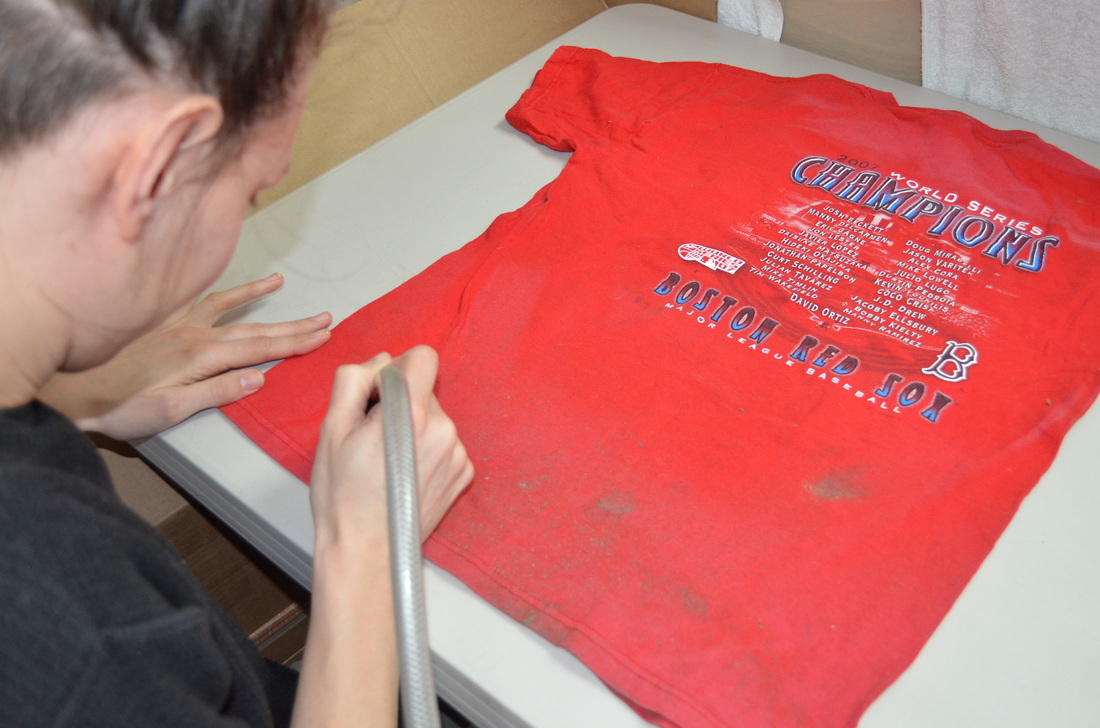 Conservation assistant Lisa Yeats reducing soil deposits on a shirt prior to exhibition. Photo courtesy of Museum Textile Services. About Museum Textile Services
Museum Textile Services, the premier textile conservation studio in New England, specializes in the preservation of fabric-based materials for cultural institutions and individuals. Museum Textile Services documents, cleans, stabilizes, and mounts historic textiles. Through educational programs and outreach initiatives, Museum Textile Services teaches individuals and cultural heritage institutions how to ensure better preservation of their textiles. For more information, visit www.museumtextiles.com. ### FOR IMMEDIATE RELEASE Contact: Sidney Pietrak or Barbara Ward, (603) 430-7968 Sampler Study Day, Saturday November 2, 2013 Sponsored by the Moffatt-Ladd House & Garden and Museum Textile Services The Moffatt-Ladd House and Garden and Museum Textile Services of Andover, Mass. will host a Sampler Study Day at the Moffatt-Ladd Warehouse on Saturday, November 2, 2013 from 10AM – 1:00PM. This event is for individuals who own antique needlework samplers and pictorial embroideries and would like to learn more about the condition, significance, and proper care of these textiles. Members of the public are invited to bring their samplers to the Moffatt-Ladd and Garden Warehouse on Sampler Study Day for a professional evaluation. The fee to participate in this program is $15 for the first sampler, and $10 for each additional sampler. Camille Myers Breeze is a textile conservator with over 20 years of experience in the field. She is the founder and director of Museum Textile Services, a full-service textile preservation studio providing conservation, collections management and outreach for collectors and institutions. Breeze will evaluate the condition of each sampler brought to the event and provide participants with a one-page conservation worksheet. She will also discuss potential conservation issues and make recommendations for the appropriate mounting and framing of these heirlooms. Moffatt-Ladd House director/curator, Barbara Ward, Portsmouth Historical Society Curator Sandra Rux, and Moffatt-Ladd House Museum Properties Chairman Sherry Cullimore will share information related to the age, decorative motifs, and overall style of each sampler. They will also provide resources for researching the history of a sampler's maker. To ensure the long-term preservation of these textiles. Additionally, Museum Textile Services staff will be available to advise participants on the proper care of samplers, including optimal storage and environmental conditions. Moffatt-Ladd House staff and NSCDA-NH volunteers will help participants complete a short survey to include their samplers in a searchable online database administered by the National Society of the Colonial Dames of America (www.nscda.org). The goal of the NSCDA Sampler Survey is to inventory all extant samplers and pictorial embroideries in museums and private collections to promote the preservation and study of this important art form. Samplers and pictorial embroideries were a popular form of needlework in America between the 17th and 19th centuries, and were often produced by schoolgirls and young women as a demonstration of their skill in this domestic art. Today, these textiles provide valuable information about the social and cultural history of women during this period. Samplers may feature the alphabet; religious or moral quotations; decorative figures, motifs and borders; and sometimes the name of the maker and the date of creation. To attend Sampler Study Day please register by contacting Barbara Ward or Sidney Pietrak at the Moffatt-Ladd House and Garden at (603) 430-7968 or by writing to us at programs@moffattladd.org before October 30, 2013. Drop-ins are welcome and will be accommodated as time permits. The Moffatt-Ladd Warehouse is located on the grounds of the Moffatt-Ladd House and Garden at 154 Market Street, in Portsmouth, NH. For directions, call or see our website at www.moffattladd.org. FOR IMMEDIATE RELEASE
Sampler Study Day, January 26, 2013 Sponsored by the Peabody Historical Society & Museum Textile Services December 18, 2012 – The Peabody Historical Society of Peabody, Mass. and Museum Textile Services of Andover, Mass. will host a Sampler Study Day at the Historical Society's Smith Barn at 38 Felton Street, Peabody on Saturday, January 26, 2013 from 10-12. This event is for individuals who own antique needlework samplers and pictorial embroideries and would like to learn more about the condition, significance, and proper care of these textiles. Members of the public are invited to bring their samplers to the Society's Smith Barn on Sampler Study Day for a professional evaluation. The fee to participate in this program is $20 per sampler. Camille Myers Breeze is a textile conservator with over 20 years of experience in the field. She is the founder and director of Museum Textile Services, a full-service textile preservation studio providing conservation, collections management and outreach for collectors and institutions. Breeze will evaluate the condition of each sampler brought to the event and provide participants with a one-page conservation worksheet. She will also discuss potential conservation issues and make recommendations for the appropriate mounting and framing of these heirlooms. Peabody Historical Society Curator Heather Leavell and Assistant Curator Lyn FitzGerald will share information related to the age, decorative motifs, and overall style of each sampler. They will also provide resources for researching the history of a sampler's maker. To ensure the long-term preservation of these textiles, Leavell and FitzGerald will advise participants on the proper care of samplers, including optimal storage and environmental conditions. Additionally, Museum Textile Services staff will be available to help participants complete a short survey to include their samplers in a searchable online database administered by the National Society of the Colonial Dames of America (www.nscda.org). The goal of the NSCDA Sampler Survey is to inventory all extant samplers and pictorial embroideries in museums and private collections to promote the preservation and study of this important art form. Samplers and pictorial embroideries were a popular form of needlework in America between the 17th and 19th centuries, and were often produced by schoolgirls and young women as a demonstration of their skill in this domestic art. Today, these textiles provide valuable information about the social and cultural history of women during this period. Samplers may feature the alphabet; religious or moral quotations; decorative figures, motifs and borders; and sometimes the name of the maker and the date of creation. To attend Sampler Study Day please register by contacting Heather Leavell at the Peabody Historical Society at 978-977-0514 or heather.leavell@peabodyhistorical.org by Wednesday, January 23, 2013. Drop-ins are welcome and will be accommodated as time permits. The Peabody Historical Society's Smith Barn is conveniently located off of Route 114, near the NorthShore Mall. For directions and other information, visit www.peabodyhistorical.org, or call 978-977-0514. The 30th Annual Northeast Conference on Andean Archaeology and Ethnohistory will take place October 15-16, 2011 at the R.S. Peabody Museum of Archaeology in Andover. Andover, Mass. – Camille Breeze, Director and Chief Conservator at Museum Textile Services, will be speaking at the 30th Annual Northeast Conference on Andean Archaeology and Ethnohistory. The conference will be held at the R.S. Peabody Museum of Archaeology in Andover, Massachusetts, October 14-16, 2011. On Saturday, October 15, Camille will share her experiences as Director of the Ancient Peruvian Textiles Workshop. Camille established the Ancient Peruvian Textiles Workshop in collaboration with Rommel Angles Falcon, Director of the Municipal Museum of Huaca Malena, in 2004. The need for the project was first documented by Rommel. In 2008, Camille published a paper documenting the project’s development and success. 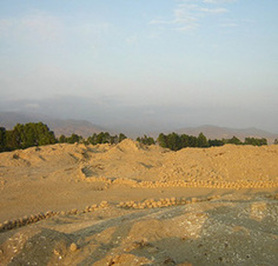
Huaca Malena is a pre-Inca ceremonial complex. During the period of regional development, 400–500 A.D., it functioned as an administrative and religious center. Between 700 and 1100 A.D. the upper platform was used by the Wari culture as a cemetery.
To the ancient Peruvians, textiles played a fundamental role in the dispersion of political and religious ideology. They were used to clothe the body, both in life and in death, as well as for social functions such as paying taxes. Every hand-weaving technique invented anywhere in the world was also known to the ancient Peruvians, which illustrates their ingenuity and resourcefulness. It is this unique textile legacy that has brought North Americans to the Municipal Museum of Huaca Malena to collaborate with Peruvians in the conservation of artifacts from the collection. Over the course of five years more than forty textiles, mummy bundles, and mummified heads were conserved by forty-four participants in this collaborative effort. The 30th Annual Northeast Conference on Andean Archaeology and Ethnohistory will begin with an informal gathering on the evening of Oct 14, will continue on the 15th with plenary session talks, a reception, dinner, and a keynote talk by Richard Burger (Yale University) on Hiram Bingham and Machu Picchu, and will conclude with a half day of plenary session talks on the 16th. For more information, or to register for the conference, please visit the conference website. About Museum Textile Services Museum Textile Services, the premier textile conservation studio in New England, specializes in the preservation of fabric-based materials for cultural institutions and individuals. Museum Textile Services documents, cleans, stabilizes and mounts historic textiles. Through educational programs and outreach initiatives, Museum Textile Services teaches individuals and cultural heritage institutions how to ensure better preservation of their textiles. For more information, visit www.museumtextiles.com. New site provides improved navigation, a new blog and a rich array of textile conservation resources for museum professionals, conservators and private collectors.
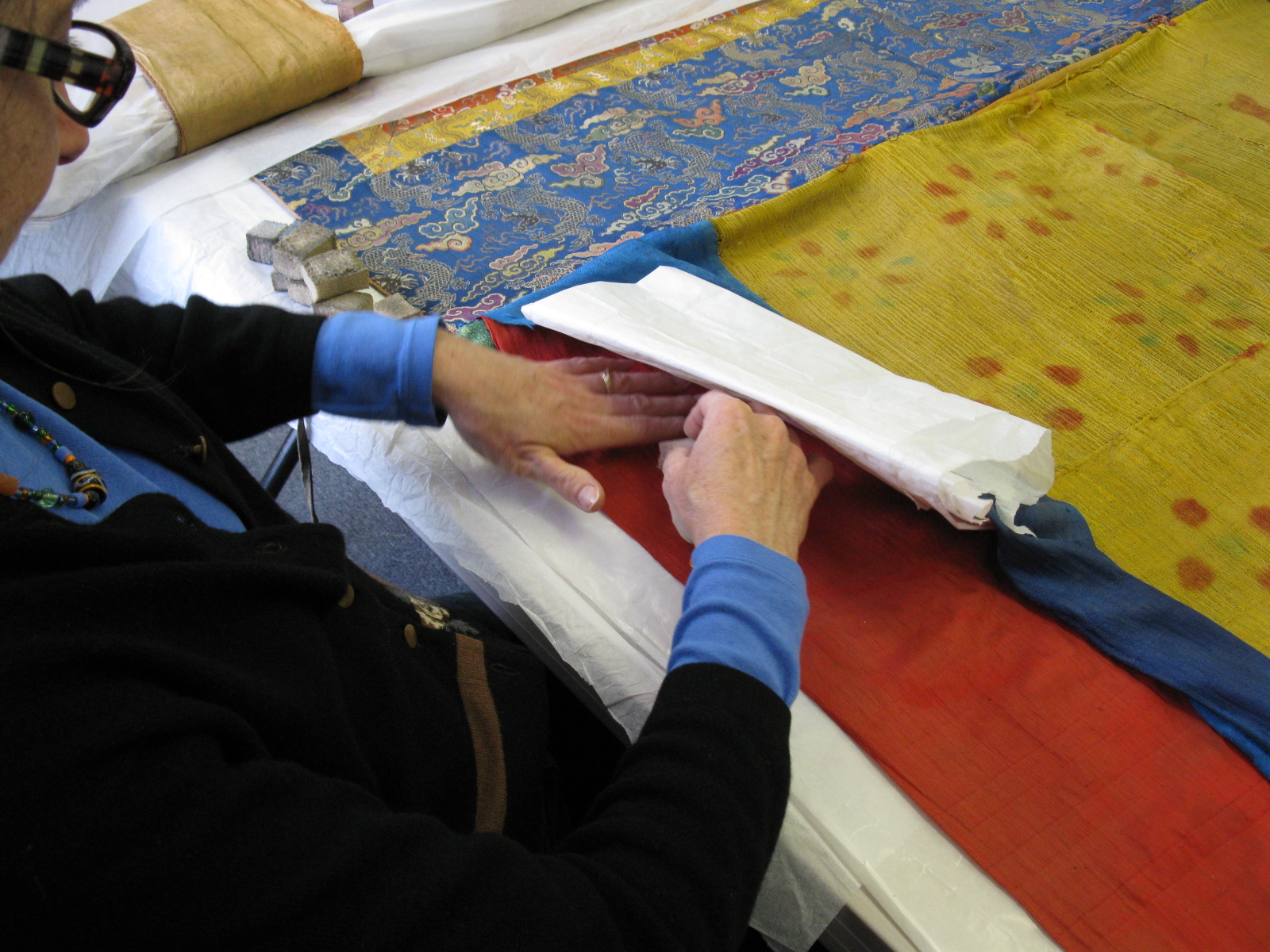
Andover, Mass. – Museum Textile Services has launched its new website. The redesigned site at www.museumtextiles.com, created by staff and interns, embodies the company’s forward-thinking vision and commitment to the growing needs of cultural heritage institutions and those who own historic textiles. The new website offers improved navigation, a new blog and a rich array of textile conservation resources for museum professionals, conservators and private collectors. The website’s homepage welcomes visitors with a simple design and clear navigation bar. It also provides direct links to connect with the organization on various social media sites, including Facebook, Twitter and Flickr. Visitors to the site can also sign up for occasional email newsletters filled with resources and textile-related news. “We’re so pleased that our new website is up because it makes it so much simpler to get information to visitors,” said Camille Breeze, Director and Chief Conservator at Museum Textile Services. “The individual pages in the Conservation section really showcase the amazing projects we’ve been involved in and tie those projects in with research and scholarship on those topics.” One of the greatest aspects of the new site is that it can be updated easily. This allows Museum Textile Services to share new information as soon as it becomes available. “Our Education and Disaster Response pages are a wealth of free information about textile conservation, collections care and becoming a conservator – definitely our most frequently asked questions,” said Camille. Now, staff and interns can share conservation stories and answer questions on the MTS Blog. Blog posts and photo uploads help visitors access the depth of services available and provide further opportunities for hands-on learning for interns, who have always been an important part of the work done at Museum Textile Services. “It’s also great to see the gallery of past interns, all of whom have made such great contributions to MTS,” said Camille. “We look forward to feedback from our users and exciting new developments to come.” About Museum Textile Services Museum Textile Services, the premier textile conservation studio in New England, specializes in the preservation of fabric-based materials for cultural institutions and individuals. Museum Textile Services documents, cleans, stabilizes and mounts historic textiles. Through educational programs and outreach initiatives, Museum Textile Services teaches individuals and cultural heritage institutions how to ensure better preservation of their textiles. For more information, visit www.museumtextiles.com. Andover, Mass. – Museum Textile Services will turn over the last of 18 Tibetan thangkas to the Mead Art Museum at Amherst College next month. The thangkas – cloth paintings depicting Buddhist deities and symbols, sewn into fine silk textiles – were the focus of a two-year conservation project. Picturing Enlightenment: Thangkas in the Mead Art Museum at Amherst College will open August 26, 2011. This will be the first time the thangkas have been seen by the public since 1953. To protect these fragile objects from the potentially damaging effects of light, the collection will be displayed in two parts. The first group of 10 thangkas will be on view from August 26, 2011 to January 1, 2012. To accommodate the careful exchange of the works, the exhibit will close briefly and the remaining eight thangkas will be displayed from January 20 to June 3, 2012. Camille Breeze, Director of Museum Textile Services was thrilled to work with the staff at the Mead Art Museum. “In April 2009 Collections Manager Stephen Fisher called us to survey the collection of thangkas. As a part of that process, we examined each piece, took extensive photographs and recorded measurements, construction details and current condition. The thangkas had been in archival storage for several years and were extremely fragile. When Elizabeth Barker, Director and Chief Curator, discovered the thangka collection, she really wanted to make them accessible – first through an exhibition and then later for study.” A few months later, the thangkas made their way to Museum Textile Services, where they were gently cleaned, the painted surfaces stabilized and the silk supports reinforced. “We cleaned the thangkas with a gentle hand vacuum and vulcanized rubber sponges that absorb and remove a lot of the dirt and grime that accumulates over time. The thangkas were covered in an oily residue, which is probably from the traditional yak butter lamps used in Tibetan culture,” said Camille. “We took a lot of time reinforcing the silk supports to ensure that the thangkas would not be damaged when they are exhibited this fall.” 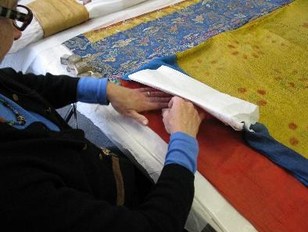 Museum Textile Services used vulcanized rubber sponges to gently clean the Tibetan Thangkas. This August, the last of the thangkas will be returned to the Mead Art Museum. "We have really enjoyed learning about the thangkas and Tibetan Buddhism," said Camille. "From a conservation perspective, this project had a lot of exciting challenges. Thangkas consist of two distinct components - the painting and the textile boarder - that are conserved in two very different ways. It allowed our team to draw upon all of our skills as conservators." About Tibetan Thangkas Thangkas function as objects of Buddhist meditation. They are also used as teaching aids and serve as a visual recording of history. Each thangka has a central painting surrounded by a fabric mount, usually made of Chinese silk. This fabric can become damaged over time from rolling, moisture, light exposure and the weight of the hanging thangka. Many thangkas have a silk veil that hangs over the image and can be raised and held in place by a silk cord for viewing. The images depict Buddha, bodhisattvas, other deities or eminent monks. The deliberately conservative artistic styles and iconographic forms used by painters of thangkas have changed little over the course of this thousand-year tradition. During the painting process, the artist performs specific rights. At its completion, a consecration ceremony called the "opening of the eyes" ensures that the resulting image is an accurate reflection of the deity depicted. Most of the thangkas in the Mead's collection were commissioned for a single monastery in Lhasa, Tibet. Religious leaders specified the paintings' subjects and the completed thangkas were displayed in groups, sometimes numbering more than one hundred in a single room. About the Mead Art Museum
The Mead Art Museum houses the art collection of Amherst College, totaling more than 16,000 works. An accredited member of the American Association of Museums, the Mead participates in Museums10, a regional cultural collaboration. During the academic term, the museum is open Tuesday through Thursday and Sunday from 9 a.m. to midnight and from 9 a.m. to 5 p.m. Friday and Saturday. For more information, including a complete schedule of events, all free and open to the public, please visit the museum’s website. About Museum Textile Services Museum Textile Services, the premier textile conservation studio in New England, specializes in the preservation of fabric-based materials for cultural institutions and individuals. Museum Textile Services documents, cleans, stabilizes and mounts historic textiles. Through educational programs and outreach initiatives, Museum Textile Services teaches individuals and cultural heritage institutions how to ensure better preservation of their textiles. Accompanying Image A high resolution copy of the image included above can be downloaded here. |
Press Contact
Camille Breeze Categories
All
Subscribe to RSS Feed
|

 RSS Feed